
 WorkForce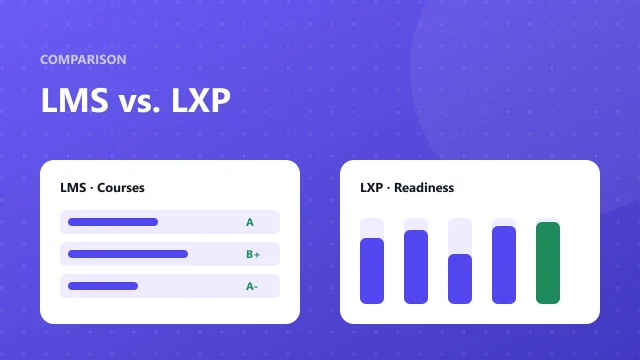
LMS vs. LXP: what is the difference, and which one do you need?
A learning management system runs courses. A learning experience platform builds capability. Here is how they compare, and when you need one, the other or both.
 by TatvaOne.AI
 Take a 2-minute product tour
Watch the tour
Take a 2-minute product tour
Watch the tour
Four ways to protect an online exam, compared on coverage, fairness, evidence, scale and cost, and when each one makes sense.
For most high-stakes exams at scale, AI with human review gives you the coverage of automation and the judgement of people: every session is monitored, every flag is checked by a person, and the institution gets evidence it can stand behind. Live proctoring still makes sense for small, very high-stakes sittings. Record and review and AI-only tools fit practice and low-stakes tests, where no one has to defend a decision.
| Criteria | AI + human reviewProctorly | Live human proctoring | Record and review | AI-only (automated) |
|---|---|---|---|---|
| How it works | AI monitors every session and raises flags; trained proctors review each flag; the institution makes the final call | A proctor watches a small group of candidates on webcam in real time | Sessions are recorded and reviewed afterwards, often only a sample | Software monitors the session and scores or decides on its own |
| Scales to large cohorts | Yes. Reviewers only spend time on flagged moments | Limited. Capacity depends on proctor numbers and booked slots | Partial. Recording scales; review effort grows with every hour recorded | Yes |
| Catches device-level cheating (AI assistants, overlay apps, virtual machines, remote access) | Yes. Device and screen signals sit alongside camera checks | Partial. Only what a proctor can see on camera or a shared screen | Partial. Camera and screen only, and only after the exam | Depends on the tool |
| A person reviews every flag before it counts | Yes | Yes, in the moment | Only if every recording is reviewed | No |
| Can step in during the exam | Yes, with live monitoring | Yes | No | Rarely |
| Evidence for appeals | Integrity report per candidate: clips, snapshots and the reviewer's decision | Proctor notes; recordings only if also enabled | Recordings, but decisions are not always documented | Scores and flags that can be hard to explain |
| Scheduling for candidates | On demand or scheduled | Booked time slots | On demand | On demand |
| Cost profile | Moderate. Human time goes to flagged moments only | Highest. Cost rises with every candidate hour | Low to moderate. Rises with review coverage | Lowest, with a higher risk of contested results |
High-stakes semester, entrance and certification exams at scale
Small cohorts where a proctor must watch every minute
Low-stakes quizzes and practice tests
Practice tests where no decision depends on the result
Most proctoring comparisons start with features: face matching, browser lockdown, room scans. Those matter, but the bigger question is who decides when something looks wrong. That choice shapes how many honest candidates get flagged, how quickly results are released, and whether a decision survives an appeal.
The four models above answer it differently. AI-only tools let software decide. Record and review moves the decision to after the exam, often based on a sample. Live proctoring puts a person in the room, at a cost that grows with every candidate. AI with human review uses software to watch everything and people to judge what it finds.
See how Proctorly combines AI monitoring with human review, or read why every AI flag needs a human.
For practice tests, often yes. For exams that affect grades, admission or certification, no. Every automated detector produces false positives, so a trained person should review each flag before it counts against a candidate.
Not necessarily. A live proctor sees what the camera shows, but many current methods, such as AI assistants, overlay apps and virtual machines, never appear on camera. Device-level checks combined with human review cover more of them.
Software monitors every session, so people only spend time on the moments it flags rather than watching every minute of every exam.
The institution. Proctorly flags, trained proctors review each flag with the evidence, and the institution receives an integrity report per candidate and decides.
30 minutes with a specialist for your role.
30 minutes with a specialist for your role and country. Pick a time straight away.
30-minute call · choose a day and time